
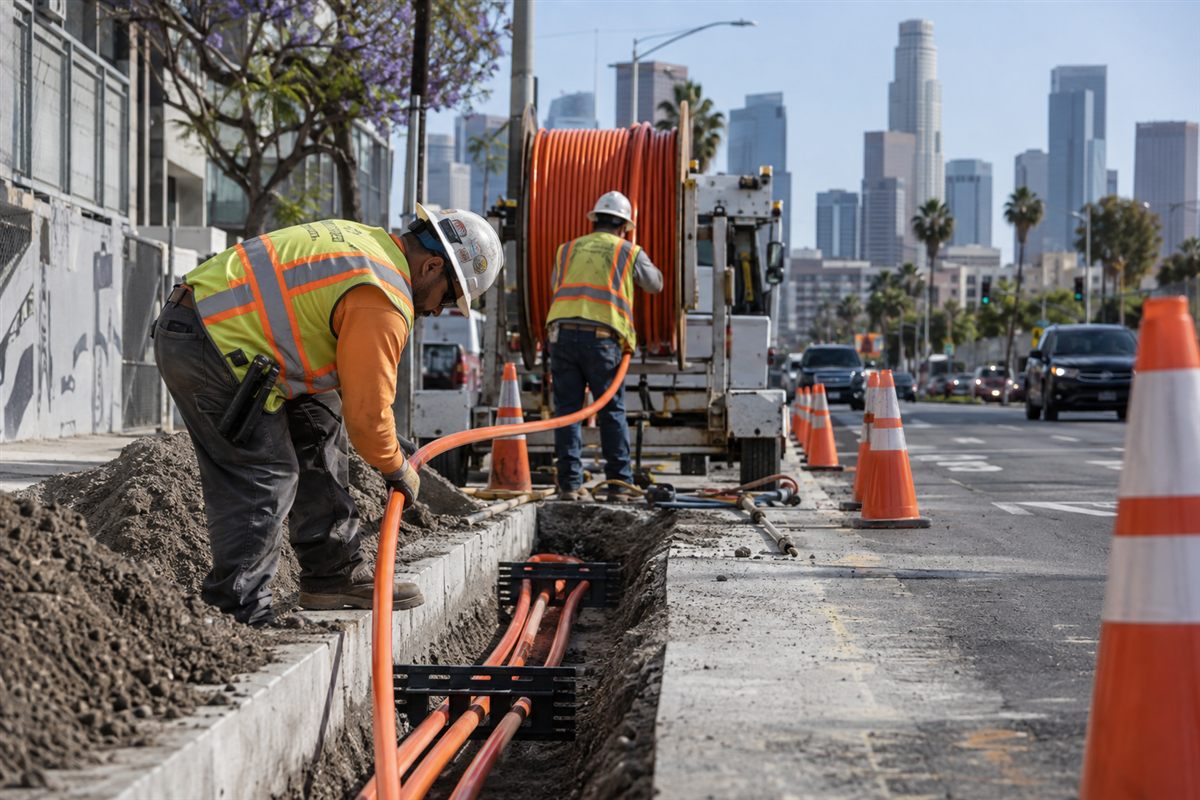
What BOE calls telecommunication utilities
In the U-Permit overview, BOE describes telecommunication or dry utilities as including phone, video, internet, and data-transmission cables. It says these are primarily low-voltage wire, cable, or fiber communications network companies.
This category is part of the manual’s broader U-Permit definition, which addresses public utilities and telecommunication companies regulated by the State Public Utilities Commission installing public utilities in the public right-of-way. Naming a cable type alone does not establish the permit needed for a particular project.
How the manual describes AGFs
BOE describes Above Ground Facility (AGF) applications as utility or telecommunication applications that accompany Excavation U, Excavation E, and Revocable permits with above-ground components. It points to Los Angeles Municipal Code Section 62.08 for AGF specifications and procedures.
The manual also says AGFs generally require supplemental power permits to power the facilities, and that these are permitted under the Excavation U-Permit once the AGF application is approved. The words “generally” and “once” are important: an AGF should not be treated as automatically covered without reviewing the current process and the associated permit context.
Questions to bring to a scope review
Identify whether the project includes underground cable or conduit, an above-ground component, or both. Note the work limits and the permit context already under consideration. Then consult BOE’s AGF material and the relevant City reviewers for the application path. This is an orientation to source language, not a project-specific determination.
Information should be verified against current City of Los Angeles Bureau of Engineering requirements. This guide is informational and is not a permit determination.